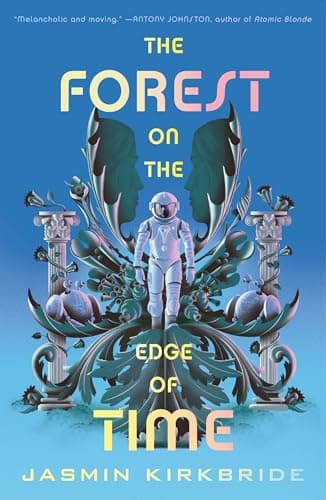
Review summary
A time-travel climate novel about family, duty, and a forest positioned at the boundary between threatened worlds and possible futures.
Full review
The Forest on the Edge of Time uses time travel and climate crisis to examine what families owe one another and what one generation can reasonably sacrifice for futures it will never see. Its forest is both a living ecosystem and a boundary between threatened possibilities.
Jasmin Kirkbride favors emotional and ecological consequence over gadget-focused time travel. Changes across eras accumulate through relationships, duty, and competing definitions of what it means to save a world.
Climate fiction across timelines
The novel treats environmental collapse as a chain of choices rather than a single disaster. Time travel makes those consequences visible without making them easy to reverse.
Who should read it
It suits readers of character-driven climate fiction, family stories, botanical speculation, and nonlinear narratives with a reflective pace.
Key ideas
- Saving a future can impose costs on people living in the present.
- Forests preserve relationships across timescales longer than one human life.
- Duty changes meaning when family and planet demand incompatible choices.
If you liked this, read next
FAQ
- Is The Forest on the Edge of Time climate fiction?
- Yes. Climate, ecosystems, time travel, family, and responsibility are central to the novel.
- Is it action-focused?
- It contains speculative stakes, but its strongest emphasis is on relationships, consequences, and the worlds characters attempt to preserve.
Reading guide
- Keep a simple timeline.
- Track who defines the forest as resource, refuge, or responsibility.
- Notice how family memories change across interventions.
As an Amazon Associate, I earn from qualifying purchases.