Review summary
Humanity's last ark approaches a terraformed world where uplifted spiders have built a civilization, forcing two evolutionary histories toward contact, conflict, and an uncertain shared future.
Full review
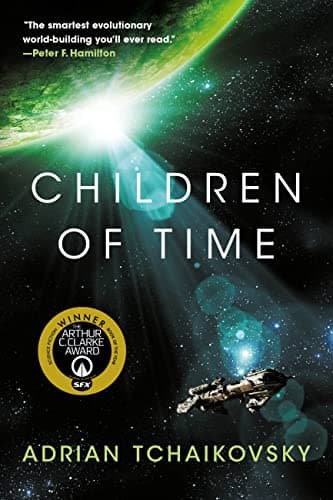
Children of Time alternates between the remnants of humanity aboard the Gilgamesh and generations of Portia labiata spiders on a terraformed planet. An uplift virus accelerates the spiders' intelligence while their society develops through biology unlike humanity's own.
The enormous time scale never loses its emotional center because scientific discovery, religion, conflict, and cooperation recur through recognizable spider lineages. The eventual contact asks whether intelligence can meet difference without repeating conquest.
Evolution as civilization
Spider anatomy shapes technology, communication, gender, and social power instead of reproducing human culture in disguise.
Difficulty and audience
The science is clearly explained and the alternating structure supplies momentum. It is ideal for readers who enjoy deep time, uplift, and nonhuman perspectives.
Key ideas
- Intelligence does not need a human form.
- Culture evolves alongside biology.
- Empathy can become survival technology.
If you liked this, read next
FAQ
- Is Children of Time the first book?
- Yes. It begins the Children of Time series.
- Is it hard science fiction?
- It uses detailed evolutionary and ecological speculation while keeping the main ideas accessible.
Reading guide
- Track recurring spider names as lineages.
- Compare human stagnation with Portiid change.
- Notice how each species defines monstrosity.
As an Amazon Associate, I earn from qualifying purchases.