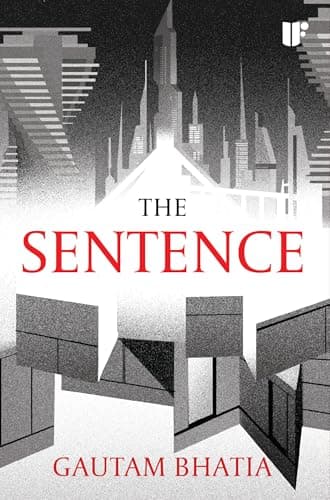
Review summary
A speculative legal novel that places punishment, rights, and institutional power under pressure through a sentence whose consequences force difficult questions about justice and human agency.
Full review
The Sentence uses speculative fiction to place a legal punishment and the institution enforcing it under sustained moral pressure. Gautam Bhatia draws on his work with constitutional rights to ask what justice means when law can administer consequences that reshape a person's future.
The novel's strongest interest is not courtroom cleverness alone but the conflict among legality, ethics, and power. Readers who enjoy political science fiction will find a compact framework for questions that resist a clean verdict.
Law as speculative technology
The central sentence makes punishment more than background worldbuilding. Its operation reveals whose suffering a system recognizes and which choices it treats as expendable.
Who should read it
This is best for readers interested in rights, institutions, moral philosophy, and Indian speculative fiction rather than action-led space adventure.
Key ideas
- A lawful punishment is not automatically a just one.
- Institutions define responsibility in ways that protect their own authority.
- Technological power can enlarge old ethical failures instead of solving them.
If you liked this, read next
FAQ
- What genre is The Sentence by Gautam Bhatia?
- It is political and legal science fiction focused on justice, rights, punishment, and institutional ethics.
- Is it part of The Wall series?
- No. It is separate from Bhatia's The Wall and The Horizon duology.
Reading guide
- Separate the legal justification from the sentence's lived effects.
- Track who is allowed to describe the punishment as necessary.
- Ask which rights remain meaningful when enforcement becomes absolute.
As an Amazon Associate, I earn from qualifying purchases.