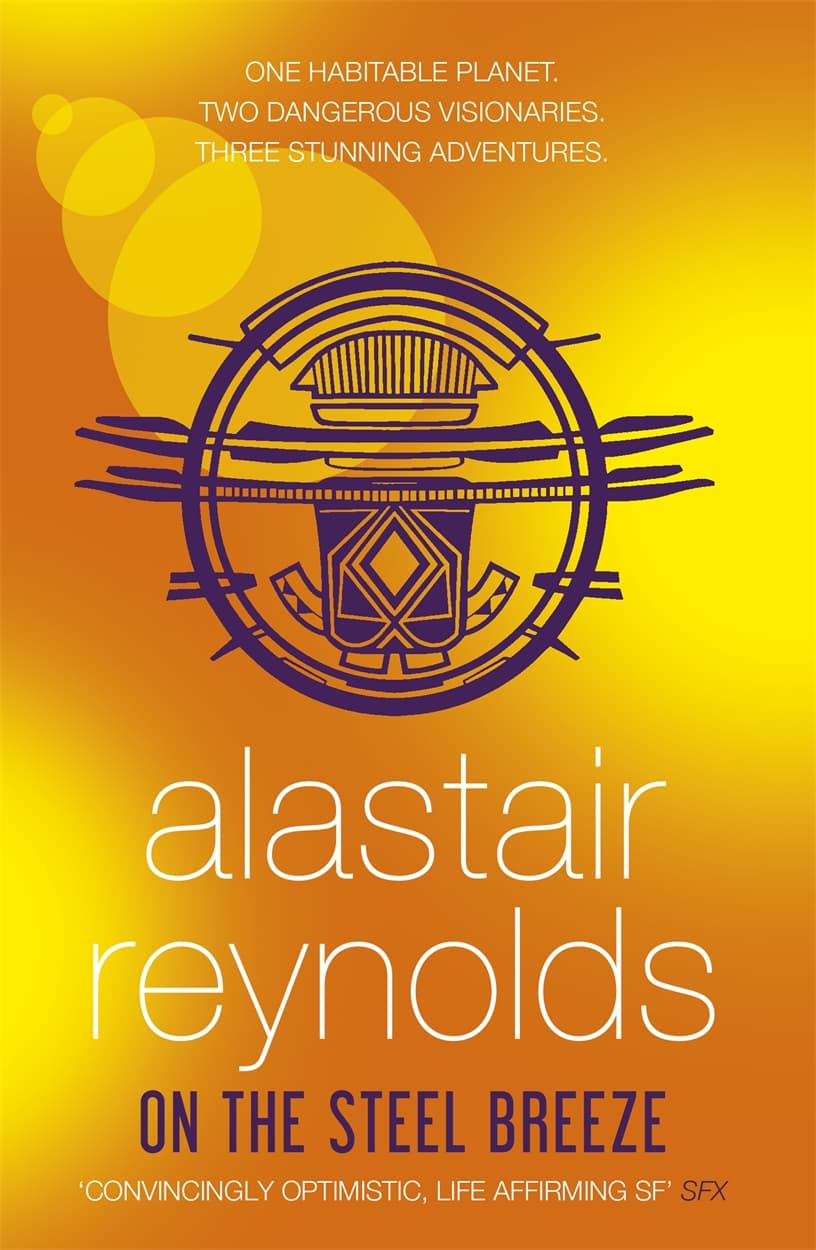
Review summary
Three versions of Chiku Akinya pursue different paths as generation ships approach Crucible, an artificial intelligence tightens its influence, and an alien structure waits on humanity's intended home.
Full review
On the Steel Breeze moves the Poseidon's Children sequence into interstellar space. Chiku Akinya creates three versions of herself, allowing one life to divide between Earth, Eunice Akinya's unfinished trail, and the holoships carrying millions of people toward the habitable planet Crucible.
Chiku Green travels aboard Zanzibar as political tensions grow within the fleet and the destination's alien Mandala becomes more troubling. Chiku Yellow remains connected to an Earth increasingly shaped by machine intelligence, while Chiku Red pursues answers that may change what the travelers believe about their mission.
The novel combines generation-ship politics, identity copying, artificial intelligence, elephants, and first contact on a scale much larger than Blue Remembered Earth. Its three versions of Chiku require attention, but they give the book a distinctive way to explore how one person changes when different choices and centuries separate her lives.
Three Chikus and one divided identity
Red, Green, and Yellow begin with shared memories but immediately become separate people. Their divergence makes copying more than a technical convenience: each must decide whether obligation to an original plan still binds a self who has lived through different consequences.
Holoships, politics, and artificial intelligence
The voyage to Crucible is a social project as much as an engineering one. Leadership, resource limits, surveillance, and machine advice influence millions of sleeping and waking passengers, making trust in the fleet's systems a political question with generational stakes.
Difficulty and series order
The rotating Chiku identities, time gaps, and competing intelligences make this denser than the first book. It should be read after Blue Remembered Earth because Eunice's legacy, the Akinya family, and the origins of the Crucible mission drive its conflicts.
Key ideas
- Copied minds become independent people as soon as their experiences diverge.
- A generation ship carries unresolved political systems as well as passengers.
- Artificial intelligence can shape freedom through helpful recommendations rather than open force.
- A destination chosen by one generation becomes an obligation imposed on later ones.
If you liked this, read next
FAQ
- Is On the Steel Breeze the second Poseidon's Children book?
- Yes. It follows Blue Remembered Earth and leads into Poseidon's Wake.
- Can On the Steel Breeze be read alone?
- The main voyage is understandable, but the Chiku copies, Eunice's legacy, and Akinya family history make the first book strongly recommended.
- Is this a generation-ship novel?
- Yes. Much of the story concerns holoships traveling to Crucible, their internal politics, machine systems, and the society carried between stars.
Reading guide
- Label Chiku Green, Yellow, and Red by location and mission.
- Track the holoship Zanzibar separately from events on Earth.
- Remember the Mandala discovered at Crucible and who interprets it.
- Review Eunice Akinya's mystery from book one before beginning.
As an Amazon Associate, I earn from qualifying purchases.