Review summary
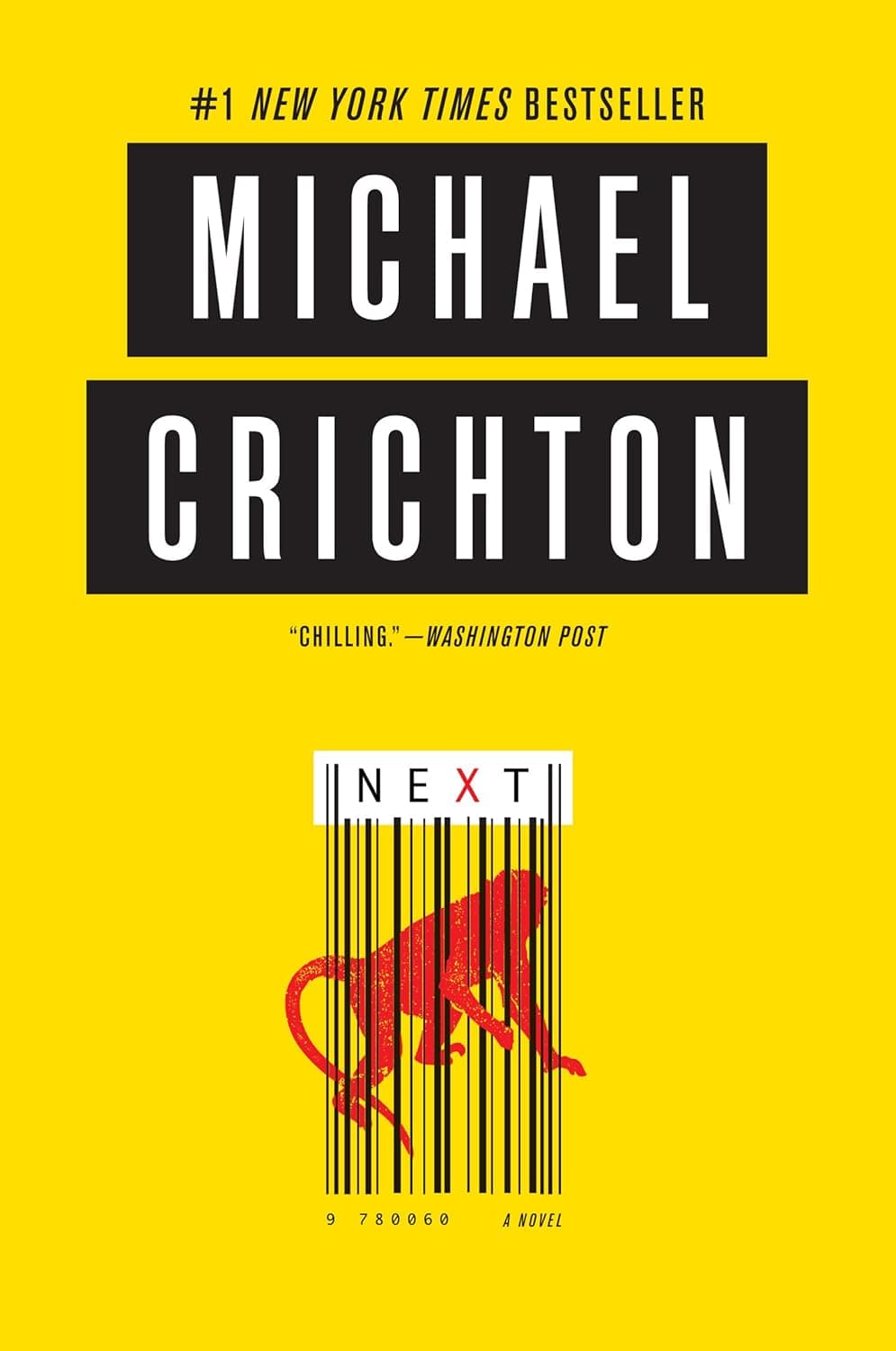
Interlocking stories about gene patents, biotechnology companies, transgenic animals, researchers, and families explore what happens when fragments of living identity can be discovered, owned, sold, and stolen.
Full review
Next uses an ensemble of scientists, families, lawyers, companies, and transgenic animals rather than one continuous protagonist. Gene patents, tissue ownership, research fraud, commercialization, and unusual hybrids intersect as biotechnology companies claim rights over biological material that remains part of living people.
The fragmented structure resembles a set of escalating case studies connected by theme. A talking parrot and a humanlike transgenic chimp provide satire and emotional focus, while legal and corporate episodes ask whether existing property rules can govern inheritance, identity, and reproduction. Some threads are deliberately absurd; others draw on recognizable disputes.
Readers expecting the focused suspense of Jurassic Park may find the many switches disruptive. The novel works better as a dark biotech panorama, energetic and argumentative rather than tightly unified. Its specific legal and genetic references have aged, but the questions about data, consent, and ownership remain relevant whenever innovation moves faster than public rules.
A network rather than one hero
Separate plots demonstrate different consequences of treating genes as information and property.
Transgenic lives
The animals are not merely inventions; their intelligence exposes the moral limits of ownership.
Law follows the laboratory
Courts and companies apply old categories to biological relationships those categories were not designed to handle.
Key ideas
- A patent claim can turn a body into disputed property.
- Innovation without consent transfers risk to subjects.
- Intelligence creates obligations that ownership language cannot resolve.
- Fragmentation reflects a field with many simultaneous consequences.
If you liked this, read next
FAQ
- Is Next connected to Jurassic Park?
- No. Both concern genetics, but their stories are separate.
- Why are there so many characters?
- The ensemble structure explores biotechnology through multiple linked cases.
- Is Next hard science fiction?
- It mixes researched genetic issues with exaggerated satire and speculation.
Reading guide
- Keep a loose list of families and companies.
- Expect satire beside thriller scenes.
- Read it as thematic ensemble fiction.
- Check current law separately from the novel's examples.
As an Amazon Associate, I earn from qualifying purchases.