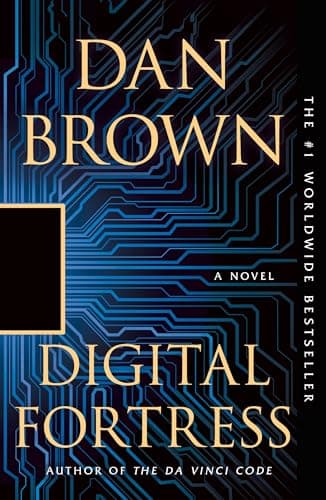
Review summary
NSA cryptographer Susan Fletcher confronts an apparently unbreakable code that threatens the agency's surveillance power, forcing her to question secrecy, loyalty, and who controls digital privacy.
Full review
Digital Fortress takes Dan Brown's puzzle-thriller formula inside the National Security Agency. Cryptographer Susan Fletcher is called in when the agency's powerful code-breaking system encounters an apparently unbreakable program, and the technical crisis quickly becomes a fight over privacy, secrecy, and institutional loyalty.
The novel moves quickly and makes cryptography easy to follow, but its late-1990s technology and security assumptions now feel dated. It works best as an energetic period techno-thriller rather than a realistic guide to modern encryption.
Privacy against national security
The central conflict asks whether an agency should possess the power to read every message simply because it claims protective intentions. Brown gives that debate personal stakes through Susan's trust in the institution.
How it reads now
Short chapters, reversals, and simultaneous crises preserve momentum. Cybersecurity-minded readers will spot implausibilities, but the surveillance questions remain recognizable.
Key ideas
- Unaccountable security power can become the threat it claims to prevent.
- Technical expertise does not protect someone from institutional deception.
- A back door weakens trust as well as encryption.
If you liked this, read next
FAQ
- Is Digital Fortress a Robert Langdon book?
- No. It is a standalone techno-thriller centered on cryptographer Susan Fletcher.
- Is the technology accurate?
- It uses real ideas about encryption and surveillance but takes substantial liberties, and many details reflect the technology of the 1990s.
Reading guide
- Separate real cryptographic concepts from thriller inventions.
- Track who controls information within the NSA.
- Notice when loyalty to people conflicts with loyalty to the agency.
As an Amazon Associate, I earn from qualifying purchases.