Review summary
This collection gathers early and previously scattered Reynolds stories, moving from Antarctic isolation and ecological games to alien rescue, deep-time revenge, and Revelation Space side tales.
Full review
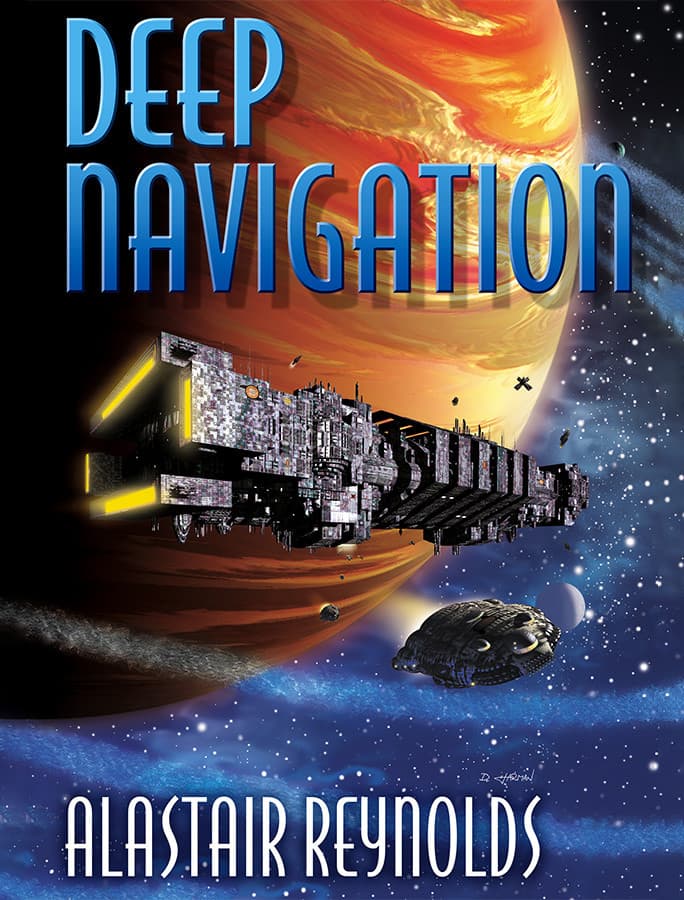
Deep Navigation collects stories from across Reynolds's early career, beginning with his first published piece, Nunivak Snowflakes, and extending to later work such as The Receivers and Monkey Suit. Stephen Baxter's introduction places that development within Reynolds's emergence as a major hard-science-fiction writer.
The settings range from a claustrophobic Antarctic research station in Byrd Land Six to the long revenge and transformation of Fury. Other pieces explore ecological conflict, machine perception, alien rescue, artistic obsession, and the danger of carrying familiar human motives into environments operating on radically different scales.
This is less a polished greatest-hits sequence than an archive of range and development. Some early stories feel rougher or more idea-driven than Reynolds's mature work, but that variation is the reason to read it. The collection shows experiments that later became his recognizable mixture of scientific scale, isolation, horror, and compromised survival.
Early work beside mature stories
Arranging pieces from different stages makes changes in voice visible. The earliest stories often prioritize concept and atmosphere, while later entries integrate scientific speculation more tightly with grief, political choice, or personal identity.
Revelation Space and independent settings
Monkey Suit belongs to the Revelation Space universe, but most of the collection does not require shared continuity. Readers can move from Antarctic suspense to cosmic-scale futures without maintaining a single timeline or glossary.
Who benefits most from the collection
Deep Navigation is best for readers already interested in Reynolds who want rarer material and evidence of his development. Newcomers seeking only the strongest or most representative stories may prefer Beyond the Aquila Rift, which is curated as a career-spanning best-of.
Key ideas
- A writer's recurring concerns become clearer when early experiments sit beside later work.
- Scientific scale produces tension most effectively when attached to a human limitation.
- Isolation can occur within a station, a planet, or millions of years.
- Collections preserve exploratory work that a best-of might smooth away.
If you liked this, read next
FAQ
- What kind of book is Deep Navigation?
- It is a collection of shorter fiction spanning early and later Reynolds work, with an introduction by Stephen Baxter.
- Is Deep Navigation part of Revelation Space?
- Most stories are independent. Monkey Suit is a Revelation Space story, while the rest range across unrelated settings and ideas.
- How is Deep Navigation different from Beyond the Aquila Rift?
- Deep Navigation emphasizes early and previously scattered material; Beyond the Aquila Rift is a larger career best-of containing many more established stories and novellas.
Reading guide
- Read the publication notes to place each story in Reynolds's career.
- Do not assume the stories share one universe.
- Compare early treatments of isolation with later deep-time narratives.
- Use Beyond the Aquila Rift instead if you want a more selective introduction.
As an Amazon Associate, I earn from qualifying purchases.