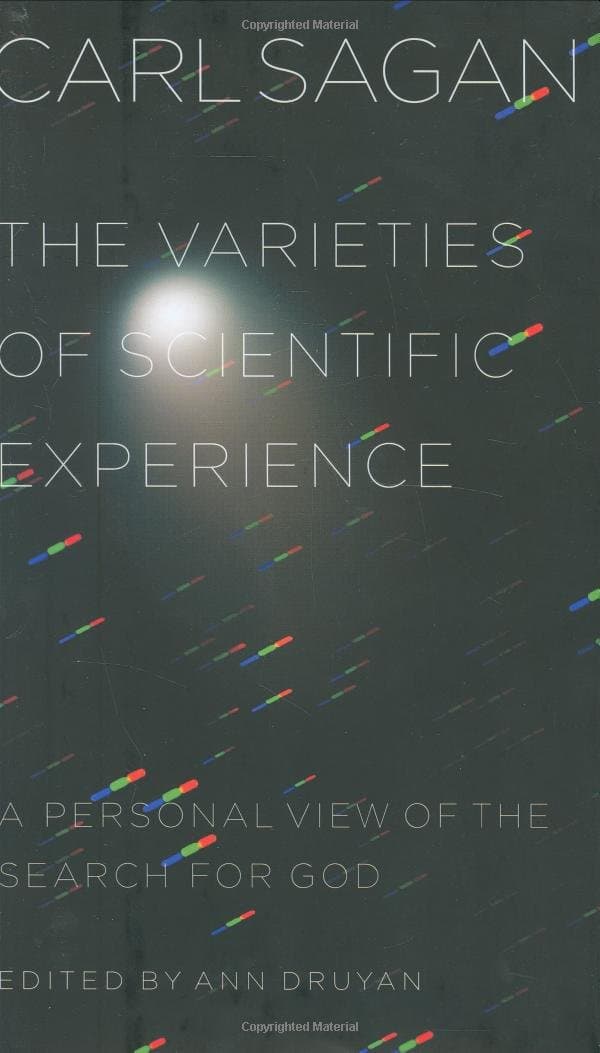
The editorial case for The Varieties of Scientific Experience
What worked
It reads like a thoughtful series of talks in which Sagan examines classic arguments for God through the lens of modern cosmology and biology.
What held it back
He is firm about evidence but careful not to mock sincere believers, which gives the book a calm and respectful tone.
The likeliest stopping point
Patience matters most around this demand: Highlight moments where Sagan connects cosmology to personal or philosophical questions and discuss which ones resonate.
Does the ending earn it?
The reward is cumulative rather than dramatic: the final chapters return to the idea that skeptical inquiry can examine religious claims without dismissing the people who hold them.
Best fit: Readers curious about how scientific and religious worldviews can clash and overlap.
Reading The Varieties of Scientific Experience closely
The Varieties of Scientific Experience collects Carl Sagan's 1985 Gifford Lectures into a single volume about science, religion, and wonder. It reads like a thoughtful series of talks in which Sagan examines classic arguments for God through the lens of modern cosmology and biology.
Sagan works through design arguments, miracles, and personal experiences of faith while explaining what astronomy, evolution, and the search for extraterrestrial intelligence can and cannot say about ultimate questions. He is firm about evidence but careful not to mock sincere believers, which gives the book a calm and respectful tone.
The result is a kind of field guide to big questions for readers who value both curiosity and skepticism. Sagan argues that scientific understanding can deepen awe rather than reduce it and that education and open discussion are some of the best tools we have against dogmatism.
Science and Faith Discussion Resources
List each argument for God's existence that Sagan discusses and summarize how he evaluates it.
Talk about Sagan's phrase "science as informed worship" and what it might mean in practice.
Compare these lectures with more recent books on science and religion to see what has changed and what has stayed the same.
Three useful comparisons
Cosmos
Carl Sagan returns to related concerns through a different premise: Cosmos earns a recommendation—the book combines science, history, and personal curiosity so that complex ideas feel vivid instead of abstract; the main reservation is that Cosmos is structured as a series of related essays rather than a linear plot, so you can read it steadily or dip into the chapters that interest you most.
Pale Blue Dot
Carl Sagan returns to related concerns through a different premise: Pale Blue Dot earns a recommendation—sagan's main argument is simple but powerful: seeing Earth as a pale blue dot encourages humility and cooperation; the main reservation is that spaceflight is presented not only as a scientific achievement but also as a reminder that our home is small, fragile, and currently unique in its ability to support life.
The Demon-Haunted World
Carl Sagan returns to related concerns through a different premise: The Demon-Haunted World earns a recommendation—instead of a dry manual, it reads like a conversation about how to tell sound science from comforting stories and confident nonsense; the main reservation is that the book is essay based and repeats some ideas for emphasis, so it is comfortable to read in short sections.
As an Amazon Associate, I earn from qualifying purchases.