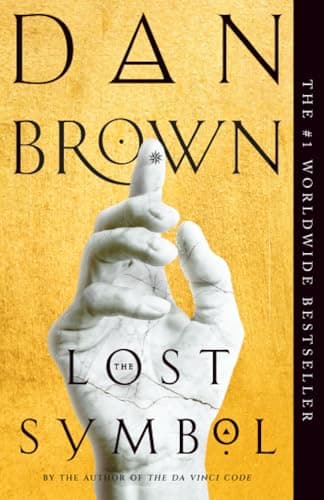
Review summary
Robert Langdon follows Masonic symbols through Washington, D.C., after his mentor is abducted, entering a race involving hidden chambers, ancient wisdom, and a ritualistic captor.
Full review
The Lost Symbol brings Robert Langdon to Washington, D.C., where an apparent invitation from his mentor Peter Solomon becomes a kidnapping and a trail of Masonic symbols. The Capitol, monuments, hidden chambers, and ritual imagery turn the city into Brown's next puzzle map.
Compared with the European settings of the earlier novels, this installment concentrates on American founding mythology, Freemasonry, and noetic science. Its single-night structure is propulsive, although repeated revelations and extended explanations make it feel longer than the clock suggests.
Washington as a symbolic city
Brown uses architecture and monuments to connect public national identity with private ritual. Familiar landmarks become clues without requiring prior knowledge of Freemasonry.
Series order
It is Robert Langdon book three after Angels & Demons and The Da Vinci Code. The case stands alone, so new readers can follow it, but earlier books establish Langdon's methods and recurring skepticism.
Key ideas
- Symbols gain power through shared interpretation rather than hidden magic alone.
- Knowledge can liberate or become leverage when one group restricts access.
- Transformation pursued without empathy turns spiritual aspiration into violence.
If you liked this, read next
FAQ
- What number is The Lost Symbol?
- It is the third Robert Langdon novel, after Angels & Demons and The Da Vinci Code.
- Do you need to read the earlier books?
- No. Its conspiracy and supporting cast are self-contained, though returning readers will already know Langdon's background.
Reading guide
- Track Masonic history separately from the villain's interpretation.
- Use a map of central Washington if you enjoy following locations.
- Notice how often physical clues point toward ideas rather than objects.
As an Amazon Associate, I earn from qualifying purchases.