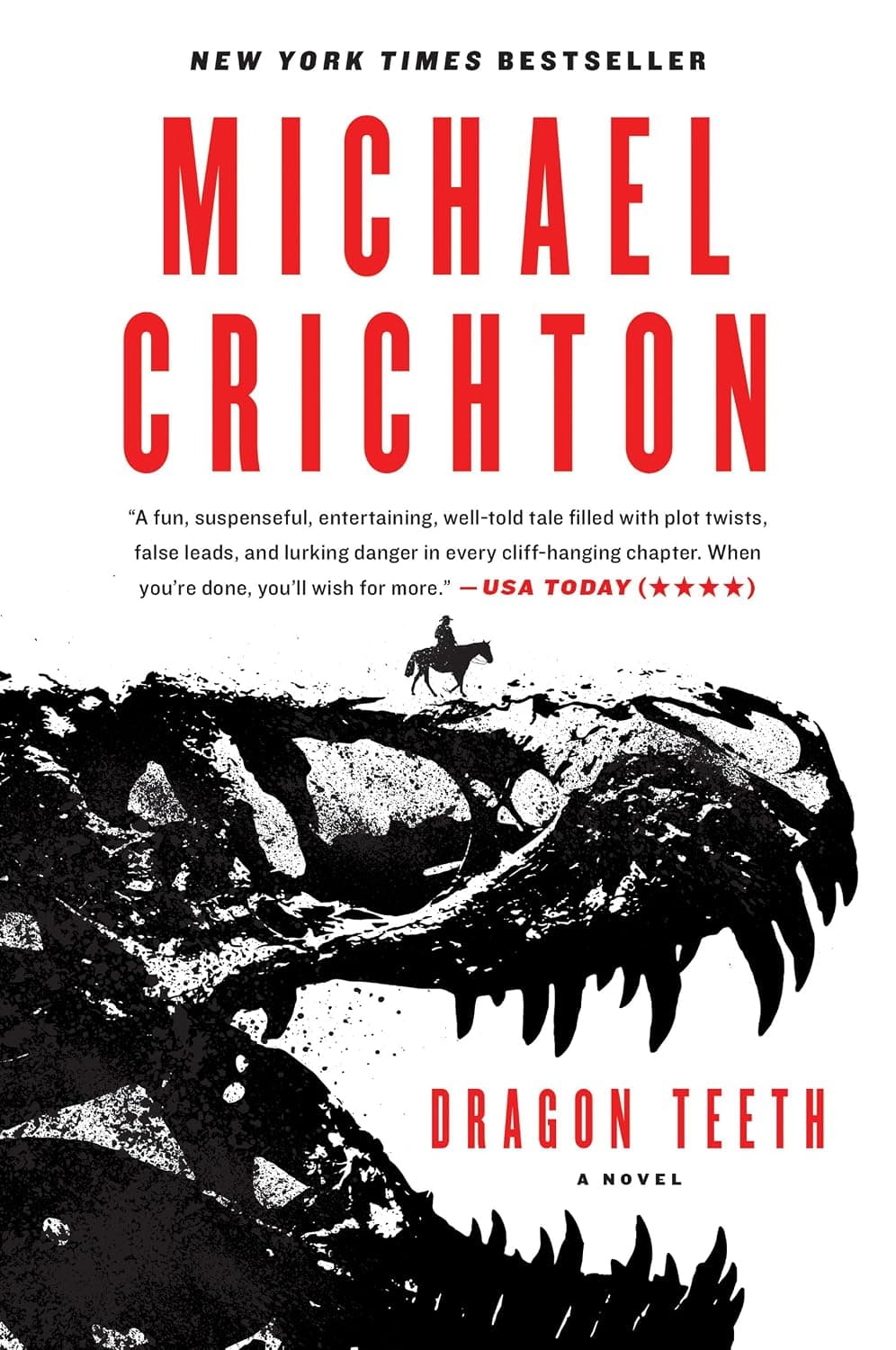
Review summary
Yale student William Johnson joins rival paleontologists Othniel Marsh and Edward Cope during the 1876 Bone Wars, carrying a major fossil discovery into a western landscape shaped by ambition and violence.
Full review
Dragon Teeth follows privileged Yale student William Johnson into the 1876 rivalry between real paleontologists Othniel Charles Marsh and Edward Drinker Cope. A wager leads him west with Marsh, suspicion drives him toward Cope, and a significant fossil discovery leaves him responsible for bones valuable enough to attract thieves and killers.
The Bone Wars supply historical absurdity and genuine scientific importance. Marsh and Cope sabotage, spy on, and discredit one another while crews work in dangerous territory. Crichton uses the fictional Johnson to travel between documented figures and frontier mythology, eventually moving from fossil camps toward Deadwood.
Published posthumously, the book is lighter and more episodic than Crichton's major thrillers. Its treatment of Indigenous people and the West should be read critically, and the adventure sometimes embraces familiar genre shorthand. Still, the combination of paleontology, rivalry, and personal maturation makes it accessible historical fiction for readers curious about the race that transformed dinosaur science.
Johnson between Marsh and Cope
His shifting employment reveals how personal rivalry shapes scientific collection and credit.
Bones as knowledge and property
A fossil can be evidence, prestige, money, and dangerous cargo depending on who claims it.
History mixed with invention
The paleontologists and Bone Wars are real; Johnson's central adventure is fictional.
Key ideas
- Scientific discovery is shaped by competition and access.
- Credit can matter more to rivals than preservation.
- Privilege does not prepare Johnson for responsibility.
- Historical fiction connects evidence by inventing a witness.
If you liked this, read next
FAQ
- Is Dragon Teeth related to Jurassic Park?
- No. It concerns nineteenth-century fossil hunters, not cloned dinosaurs.
- Is it based on true history?
- Marsh, Cope, and the Bone Wars are historical, while William Johnson's story is fictional.
- Was it published posthumously?
- Yes, in 2017.
Reading guide
- Distinguish real figures from fictional Johnson.
- Expect a western adventure as well as fossil history.
- Read portrayals of Indigenous communities critically.
- Remember it was published after Crichton's death.
As an Amazon Associate, I earn from qualifying purchases.